




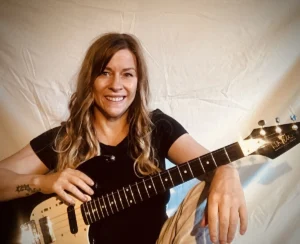
 Singer-songwriter Léanie Kaleido has released her new single, ‘Dear Seizure’, inspired by her own experience with epilepsy and the disruption it can bring.
The singer, based in the South East of England, has departed from her usual folk and piano-led sound to produce the “sharp, two-minute alt-rock” track, created with Swedish producer Jonatan Bäckelie.
Léanie explained: “After years of being seizure free thanks to my medication, my epilepsy has recently returned and turned my life upside down.
“I was angry with it, but at the same time, I find it fascinating, and I’ve always found the experience strangely difficult to explain.
“‘Dear Seizure’ became my attempt to put that feeling into words. I wanted the song to have a feisty, Jack White-style energy, but still carry a sense of vulnerability and Jonatan Bäckelie brought that to life brilliantly.
“It may not be what people expect from me, but it’s exactly what I needed to write.”
First seizure
Léanie has temporal lobe epilepsy due to a lesion on her brain that had been there since birth. She started having focal aware seizures (previously known as complex partial seizures) around the age of 14, which would appear in clusters.
She said: “My first ever seizure is something I will never forget. I stayed conscious but I had no idea what was happening.
“I was spraying hairspray and standing, looking into a mirror downstairs in our house. It was the weirdest experience ever.”
Her seizures became controlled with carbamazepine and eventually stopped. She was even able to come off her medication and remain seizure free for several years.
Epilepsy returns for the singer
 However, her epilepsy returned in her mid-20s, “worse than before”, with tonic-clonic seizures alongside the focal aware seizures.
“The carbamazepine was no longer effective at this point, and the side effects were horrible anyway, so I was pleased to come off it,” the singer explained.
“I went through every type of medication, none helping, and with horrendous side effects – foggy head, a feeling of detachment, depression and even awful wind on one drug in particular.
“At one point, the plan was to have brain surgery, but, at the time, Keppra (levetiracetam) had just come out and I was put on that as a last-ditch attempt.”
Sensitivity to different brands
The singer continued: “I have been seizure free since then, except for a couple of hiccups. One was about 18 months ago, when I was sent a different brand of levetiracetam and my brain didn’t like it. I had a cluster of focal aware and tonic-clonic seizures.
“My prescription was then amended to specify Keppra and I was fine again.”
Léanie has had a few instances of breakthrough seizures, including forgetting to take her medication and having another cluster of seizures. This meant she had to stop working, but it gave her the chance to work on her music and career as a singer and songwriter.
She added: “I have written and recorded songs for many years and have released four albums of my original songs to date. In fact, I have just been offered a record and publishing deal, so it feels great to have that validation as an artist.”
Switching between different forms of a medication
Epilepsy Action says many medications are available in both branded and generic versions – different forms of the same medicine.
People can sometimes be given a different version of their medicine for cost reasons or due to supply problems. This should only be done if it is considered safe to do so. However, in some people, it can cause breakthrough seizures.
Epilepsy medicines are split into different categories based on how safe it is considered to switch between different versions for each medicine.
- Category 1 medicines, including carbamazepine and phenytoin, should be kept as the same version.
- Category 2 medicines, including lamotrigine and perampanel, could be switched between different versions based on your doctor’s judgement and your thoughts.
- Category 3 medicines, including brivaracetam and levetiracetam, are usually safe to switch between different versions. Your doctor should still discuss with you whether a different version would be okay for you.
Epilepsy Action has more information around switching between different versions of medications and a leaflet that can be downloaded with advice and information.
‘Dear Seizure’ is available to listen to on all music platforms and to buy on Bandcamp.

Switching between different versions of epilepsy medicine
It can be worrying if you receive a different form of your usual epilepsy medicine. But there are rules to make sure the risks of switching to a different version of your medicine are low.