




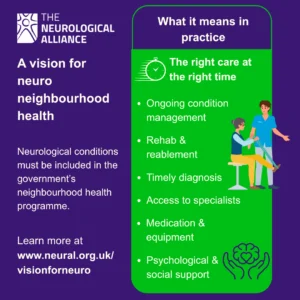
 A new report by the Neurological Alliance published this week has set out recommendations to ensure the government’s neighbourhood health programme works for people with neurological conditions, including epilepsy.
The government announced its plan for a neighbourhood health framework as part of its 10 Year Health Plan for England in March this year. This looks to bring healthcare into the local communities through NHS partnering with local authorities to deliver the care.
Now, in its report, A Vision for Neuro Neighbourhood Health, the Neurological Alliance says there is a real opportunity to improve care for the one in six people in England with a neurological condition.
The report describes neuro neighbourhood health as “specialist-informed care and support” which is delivered locally and considers the entire person, not just the condition.
This kind of care can deliver routine monitoring and rehabilitation, but maintain “continuous links” and “fast-track pathways” to specialist care are key for people whose conditions change or get worse.
The report stresses that alongside neuro neighbourhood health services, secondary and specialist services should continue to be visible and accessible to people with neurological conditions, and should all work “as a connected system”.
This health model needs to involve GPs and other health professionals, mental health practitioners and people working in the voluntary sector, the Neurological Alliance report says.
Epilepsy in neuro neighbourhood health
In epilepsy, the report makes clear that specialist care will still be essential in a number of circumstances. This includes specialist diagnosis and classification, access to neurosurgery and specialist paediatric neurologists.
People with complex or drug-resistant epilepsy would also require access to a more specialised healthcare team.
However, for those people whose epilepsy is well managed, community teams could deliver routine monitoring, prescribing and reviews, with appropriate access to specialists available as needed, the report adds.
Tom Shillito, health improvement and research manager at Epilepsy Action, said: “Epilepsy is a complex, 24/7 condition that affects every aspect of a person’s life – from their seizure control and mental health to their ability to work or drive.
“We cannot rely solely on occasional hospital appointments to manage the many challenges people with the condition face on a daily basis.
“By shifting the focus to a neighbourhood health model, we can support specialist services by delivering proactive, co-ordinated care right where people live.
“Many people with epilepsy aren’t able to drive and yet often need to travel several hours for just a short appointment with their neurologist, which adds an extra burden on what they are already dealing with.
“Having community-based epilepsy clinics can drastically cut down travel times and waiting lists for routine reviews and medication adjustments, which can ultimately reduce unnecessary emergency admissions and improve people’s overall quality of life.
“We have collaborated extensively on this project with the Neurological Alliance and look forward to continue working together to ensure we deliver better-connected systems for epilepsy and stronger community support that eases the burden on an already-overstretched NHS.”
Six steps to delivery
The report outlines six elements necessary to deliver effective neuro neighbourhood health:
- A skilled and big enough workforce
- Voluntary and community organisations as core, funded partners
- Co-production with people with neurological conditions
- Well-connected data and governance systems
- Commissioning to focus on coordination and prevention
- Equity built in
The report says neuro neighbourhood health could play a part in improving the continuity of care, provide earlier intervention and reduce worsening of people’s conditions.
The Neurological Alliance believes getting this health model right for neurology will create a blueprint for how community services could work across the board. “If neighbourhood health works for neuro, it will work for everyone.”
Read the full report on the Neurological Alliance website.