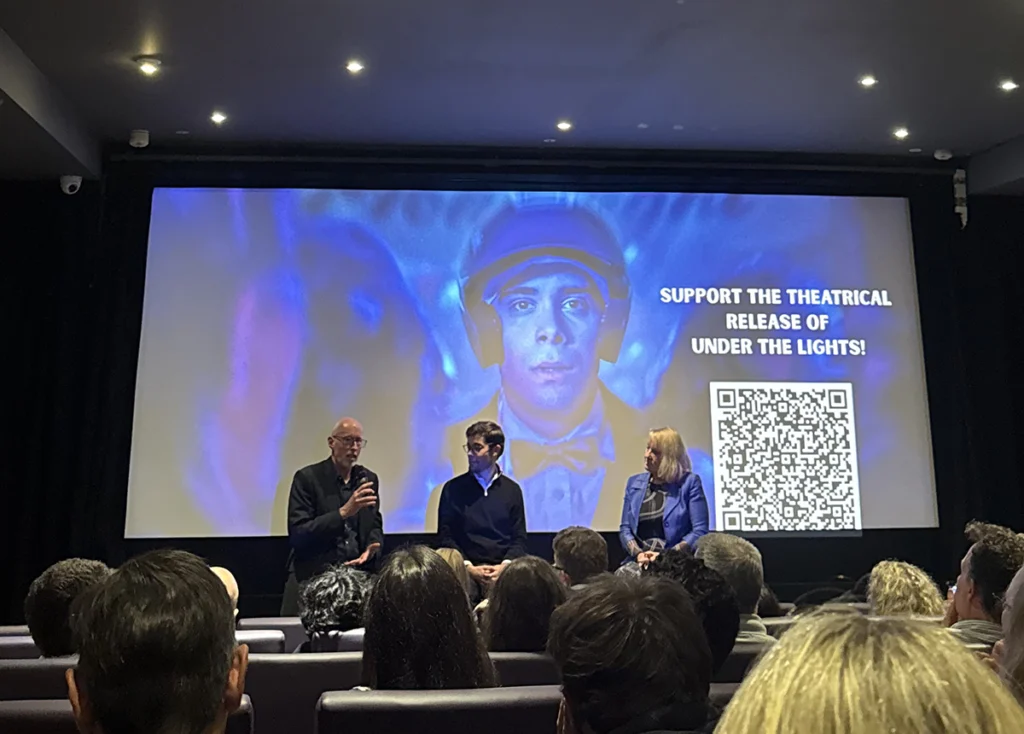



 Epilepsy film Under The Lights had its first UK screening last month at the Courthouse Hotel in London, hosted by the Epilepsy Research Institute, Kings College London and writer and director Miles Levin.
The feature-length film builds on the award winning short film of the same name written and filmed by Miles, telling the story of a boy with epilepsy risking seizure under flashing lights so he can attend his prom and have a night of normality.
The full-length film explores this theme as well as the effects of epilepsy on family and loved ones. It stars Pearce Joza, Nick Offerman, Lake Bell and Marin Hinkle, among others.
You can follow the film online or on social media for more information on screenings.
Under The Lights creating empathy and community
Speaking on the night of the screening, Miles explained that bringing his film to the UK is something really meaningful for him.
He said: “To bring the Under The Lights film to the UK, to London, is a very special moment for me. I have long dreamt of having the opportunity to go and see the world, and it never would have occurred to me when I was a teenager that it would actually be my epilepsy that would provide that bridge for an opportunity like that.
“To be able to get on an aeroplane, pack up my luggage and be here in London to show the film – to be able to share it with my friends across the pond – is everything to me, so tonight is a very big thing.”
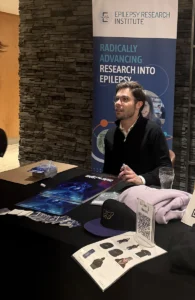 Miles believes cinema is a way to communicate with the public about important topics and hopes this film will help bring more understanding for the experience of epilepsy.
He said: “Representing epilepsy in film is really important to me because I think that it’s how we fix epilepsy stigma.
“I think for many people, it’s not necessarily seizures that are ruining people’s lives, I think a lot of the time it’s people not treating each other with respect.
“When there is a real, honest portrayal of epilepsy out in the world, like the one we have in Under The Lights, it brings out empathy.”
With his new film, Miles also wants to communicate with the epilepsy community and help people feel understood and bring them confidence.
“Something that is really special is that a lot of the time, these screenings are hosted by non-profits and people will come into these screenings having never told someone they have epilepsy,” he said.
“This is the first night they’ve ever done something epilepsy related, and they look around the room and they see a room full of people who just understand it and it reframes the way they think about themselves.”
The message Miles wants people living with epilepsy to take away from the film is simple: “The real, wonderful truth is that there are people with epilepsy today living good and exciting lives, and you can too.”
Coming of age film with an epilepsy twist
Emily Stanley, PR and media officer at Epilepsy Action, who attended the preview screening in October, said: “It was a fantastic coming of age film, but with the epilepsy-twist. The plot explored many aspects of living with epilepsy, in particular the conflict between staying safe as someone living with uncontrolled seizures, and just wanting to live a normal, independent life.
“The film explored the wider impact on family members too and even had a sub-plot following another neurological condition, which provided some bittersweet parallels. I think everyone left the cinema with that sense of you really never know how much someone could be going through invisibly.
“I laughed and I cried, and I gasped as more and more famous faces appeared throughout.
“What stayed with me the most was that following the film screening, there was an open panel. What began as a Q&A soon turned into members of the audience opening up and sharing their own stories, how epilepsy has impacted them and how the film resonated with them.
“It was beautiful to see the impact the film had already had on just these 100 people in the audience and it fills me with excitement of what could be to come when this film breaks worldwide.”
Follow Under The Lights online for more updates and information on screenings.
More articles