




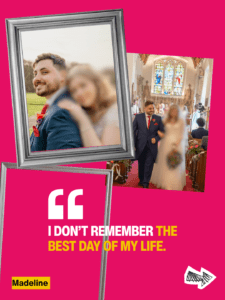
 “If I had to pick one important event, it would be my wedding day to my husband Karl. It was only 2 years ago but it feels as if every memory from the day is slowly slipping through my fingers. I can’t even recall the time I first met him 12 years ago and it pains me not to be able to cling onto that detail. Looking back, I often have the evidence that something happened, but not the emotional memory of being there. That disconnect is what I find the most difficult.
Madeline experiences gaps throughout everyday life, conversations, school experiences, and even parts of her own diagnosis journey. Rather than one moment being entirely lost, it often feels as though pieces of her story were never fully written down, leaving her with an ongoing sense that something is missing.
“What I notice most is the fragmentation of memory across my teenage years and adulthood due to seizures and medication side effects. For example, at school, it was incredibly frustrating because I was trying so hard, but the impact of epilepsy and medication on my memory wasn’t visible to others. Being misunderstood in that way made me feel isolated and, at times, like I was failing at things that others found effortless.”
Madeline relies heavily on structure on external memory supports, saying she has learned ‘forgetting less’ is less about memory itself and more about building reliable systems around it. She wants people to understand that memory problems in epilepsy aren’t a sign of carelessness or lack of intelligence, but a real neurological effect of the condition and often the medication used to treat it.
“One of the hardest parts is memory loss is invisible, so others often assume nothing is wrong. What I wish people understood most is that someone can be fully present, trying their hardest, and still not retain what they’ve been told. That doesn’t reflect effort – it reflects the challenges of epilepsy.”