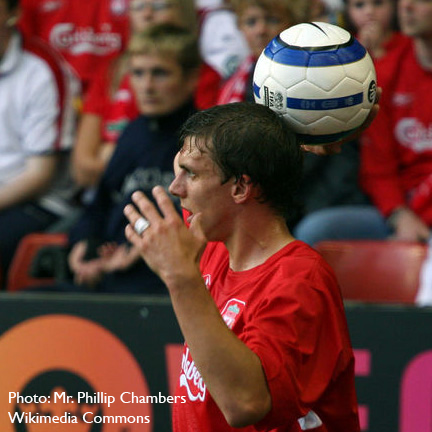


 Former professional footballer, now football pundit for 5 Live, Stephen Warnock spoke for the first time about his epilepsy on 5 Live yesterday, sharing that he hid his condition from Liverpool Football Club for fear of being released.
Following an interview with Matt Crooks on 5 Live Premier League Sunday, presenter Steve Crossman, who also has epilepsy, spoke to Stephen, 44, about his own experiences of having the condition as a child.
Stephen said: “I never wanted to tell Liverpool because I was petrified of getting released from it.”
He said he was “hugely” concerned about how seizures might affect his football. “I was thinking, ‘what happens if I’m on the pitch and suddenly it happens?’ There were no triggers for me, that was what petrified me.”
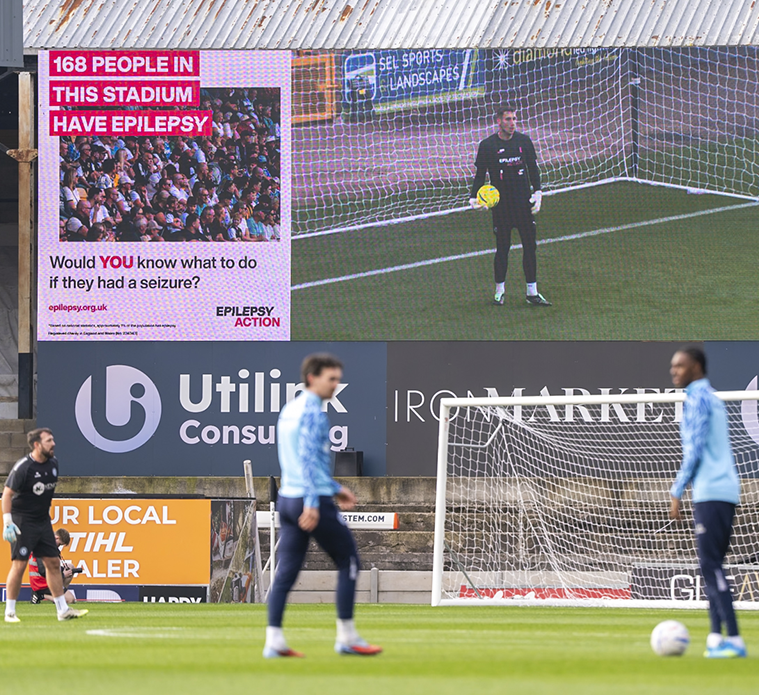
Recently, football clubs Chelsea and Port Vale have taken proactive steps to raise awareness and help promote safety for people with epilepsy. The clubs secured epilepsy training from Epilepsy Action and showcased epilepsy information on the big screen during a game.
Jon Eaton, director of communications and digital engagement at Epilepsy Action, praised Stephen for his openness now, adding that it’s not surprising he would have wanted to hide his epilepsy from his employer in the past.
He said: “Our research in 2024 found that 42% of employers knowingly discriminate against people with epilepsy even though they know this to be illegal under the Equality Act 2010.
“Together with forward thinking football clubs including Chelsea and Port Vale we are championing inclusion and a world where epilepsy is not a barrier to sporting success.
“Football isn’t always in the news for positive reasons but it’s great to see it mentioned in the context of open conversation and better understanding of often misunderstood health conditions like epilepsy.”
Stephen Warnock shares childhood seizures
Stephen started having seizures at school. He said: “I was in school, I was working on a computer, and then I woke up in a hospital bed. And I was like ‘wow, how have I got here?’ I didn’t remember anything, I completely blacked out.
“I was sort of embarrassed, if I’m being completely honest, because no one else had it, no one else knew about it, I didn’t know about it until it happened.”
A couple of weeks later, Stephen had another seizure at home while sleeping, waking up in hospital again.
“I remember another one when I was sat downstairs watching the telly. I realised something wasn’t right and the other two times I hadn’t realised what was going on, it just happened and I’d had a blackout.
“This time something was completely different where I started to see colours and started to have this strange feeling in my body and started to feel like everything was tingling.
“I remember my brother was in the bathroom upstairs getting ready to go to school and so was I, and when I went upstairs, I collapsed and headbutted the door, knocked myself out and had a seizure off the back of it.
“My brother had never seen one before and he panicked and didn’t know what had gone on and again I woke up in a hospital bed.”
While his seizures went on for around three years, Stephen said he found himself in a “fortunate position” where he outgrew his epilepsy without needing medication, with his last seizure around the age of 14.
View this post on Instagram
Afraid to talk
 In his interview, Matt Crooks shared more about his experiences with epilepsy, saying he’d knocked his front teeth out from one seizure, while he was on loan to Hartlepool.
He addressed opening up about his epilepsy, saying: “It’s not something I’m ashamed of.
“I’m still just Matt, but I understand that being in this position and having a voice that most people don’t to be able to speak on something that affects me daily, affects my family daily, and affects other people daily, if I can shine a light on it, it can help people.”
Steve and Stephen praised Matt for sharing his story and his experiences openly and showing that epilepsy doesn’t have to be a barrier or a secret.
Steve said: “One in 100 people have epilepsy, so there will be people in the Premier League who have epilepsy but are afraid to talk about it, which is really sad but it’s a reality.”
Stephen added: “I think the world is a completely different place, where we’re more open to understanding things.
“If I look back on it, I’d have learned a lot more about it back then, but it was a different time, and I shied away from it. I was a little bit embarrassed about it, because I thought I was ill, I thought I had something that no one else had, because I’d never seen it before.”
Stephen played as left-back. As well as Liverpool, he went on to play for clubs including Bradford City, Aston Villa and Leeds United as well as being part of the England squad at the 2010 FIFA World Cup.
Outgrowing epilepsy
Epilepsy Action says that children can sometimes outgrow some forms of epilepsy. One form of epilepsy which starts in childhood and is often outgrown is self-limited epilepsy with centrotemporal spikes (SeLECTS).
According to Epilepsy Action, around 1 in 15 children with epilepsy will have this type of the condition. It typically begins between four and 10 years old and stops during their teens. It affects slightly more boys than girls.
Most children with this type of epilepsy will have focal seizures, which could include a tingling feeling. These can sometimes become focal to bilateral tonic-clonic seizures, affecting both sides of the brain and causing the child to lose consciousness, fall to the floor and convulse.
Another form of epilepsy which children often outgrow is childhood absence epilepsy, in which children may have many absence seizures daily. Around six in 10 children with this form of epilepsy are expected to grow out of it by the time they reach their early teens.
There is more information on epilepsy and seizures on the Epilepsy Action website.
More articles