




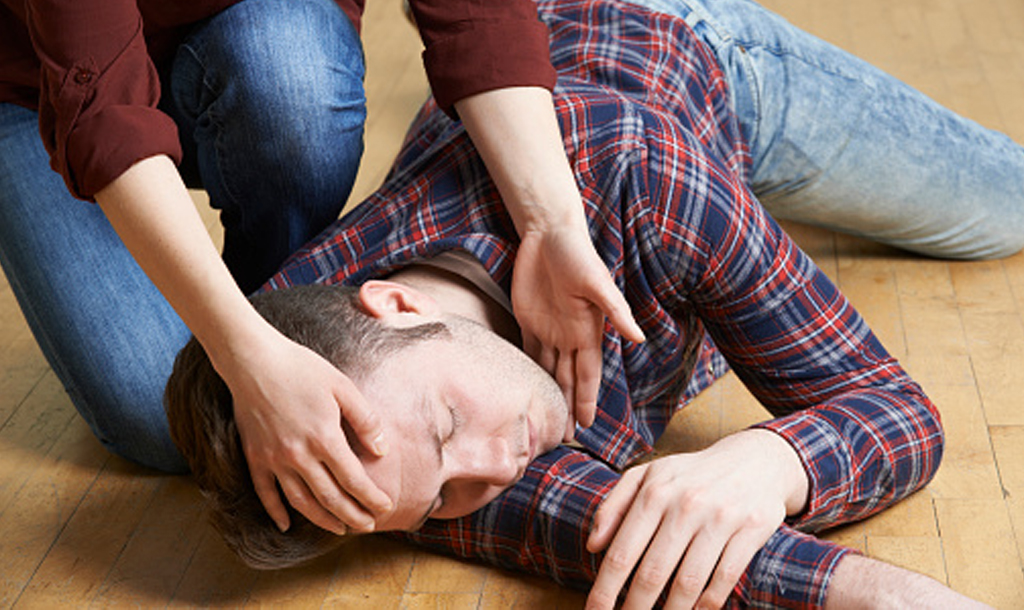
First Aid for seizures
Last checked 23/06/2008
Tonic-Clonic seizures
The person loses consciousness, the body stiffens, then falls to the ground. This is followed by jerking movements. A blue tinge around the mouth is likely. This is due to irregular breathing. Loss of bladder and/or bowel control may occur. After a minute or two the jerking movements should stop and consciousness may slowly return.
Do...
- Protect the person from injury - (remove harmful objects from nearby)
- Cushion their head
- Look for an epilepsy identity card or identity jewellery
- Aid breathing by gently placing them in the recovery position once the seizure has finished
- Be calmly reassuring
- Stay with the person until recovery is complete
Don't...
- Restrain the person
- Put anything in the person’s mouth
- Try to move the person unless they are in danger
- Give the person anything to eat or drink until they are fully recovered
- Attempt to bring them round
Call for an ambulance if...
- You know it is the person’s first seizure
- The seizure continues for more than five minutes
- One tonic-clonic seizure follows another without the person regaining consciousness between seizures
- The person is injured during the seizure
- You believe the person needs urgent medical attention
Seizures involving altered consciousness or behaviour
Simple partial seizures
Twitching, numbness, sweating, dizziness or nausea; disturbances to hearing, vision, smell or taste; a strong sense of deja vu.
Complex partial seizures
Plucking at clothes, smacking lips, swallowing repeatedly or wandering around. The person is not aware of their surroundings or of what they are doing.
Atonic seizures
Sudden loss of muscle control causing the person to fall to the ground. Recovery is quick.
Myoclonic seizures
Brief forceful jerks which can affect the whole body or just part of it. The jerking could be severe enough to make the person fall.
Absence seizures
The person may appear to be daydreaming or switching off. They are momentarily unconscious and totally unaware of what is happening around them.
Do...
- Guide the person from danger
- Look for an epilepsy identity card or identity jewellery
- Stay with the person until recovery is complete
- Be calmly reassuring
- Explain anything that they may have missed
Don't...
- Restrain the person
- Act in a way that could frighten them, such as making abrupt movements or shouting at them
- Assume the person is aware of what is happening, or what has happened
- Give the person anything to eat or drink until they are fully recovered
- Attempt to bring them round
Call for an ambulance if...
- You know it is the person's first seizure
- The seizure continues for more than five minutes
- One seizure follows another without the person regaining consciousness between them
- The person is injured during the seizure
- You believe the person needs urgent medical attention
Further information on seizures can be obtained from Epilepsy Action by using the Email Helpline or if you live in the UK, by phoning the Freephone Helpline on 0808 800 5050.
Epilepsy advice and information
- What is epilepsy?
- Children
- Depression
- Disability Discrimination Act (UK)
- Driving
- Education
- Employment
- Epilepsy in later life
- Getting a diagnosis
- Health care and welfare benefits
- Inheritance
- Learning disabilities
- Me and my dad
- Memory
- Men and Epilepsy
- Mobile phones and epilepsy
- Osteoporosis, osteomalacia and epilepsy
- Photosensitive epilepsy
- Relationships and epilepsy
- Safety
- Seizures
- Sports and leisure
- Stress and epilepsy
- Sudden Unexpected Death in Epilepsy (SUDEP)
- Syndromes
- Travel abroad
- Treatment
- Women and epilepsy
- Young people and epilepsy
- Epilepsy Action Information Reviewers (EAIRs)
- Technical editing/writing and copyright
Epilepsy Helpline
- UK freephone 0808 800 5050
- International +44 113 210 8850
- Email: helpline@epilepsy.org.uk
- Txt msg: 07797 805 390 info


Comments
I thought we have to turn the person to left (not right) am I wrong?!
I was always tought to turn them to the left as well.
Often the reason for turning an individual to left is also a matter of turning them 'away' from you. If the person goes into shock or has swallowed large amounts of water, they will vomit away from you instead of into your lap.
Any side is always better than back. Sometimes circumstances can prevail...... However, I believe there can be more oxygen exchange with some people when the right side of the lungs is upwards (that would be lying on the left side). Recall there are two lobes on lung on the left side along with the heart, and three lobes on the right side of the body. The initial basic goal is to keep oxygen / CO2 exchange going after the seizure and to reduce the risk of aspiration of vomit or secretions.
It is a common misconseption in first aid that there is a right or a wrong side to be rolled onto when put into the recovery position, either side is correct (there is also a recovery position for people on their front).
-Jay
Um i was wondering i know it says not to restrain them but is it alright to hold their head so they dont hit it on anything. My friend had a seizure while sitting in chair with her head leaned against the wall and we grabbed it & held it so she would stop hitting it on the wall. is that ok?
Hi - if someone is in danger of hitting their head, then it's a good thing to hold their head away from the source of danger. You can use your hands to cushion and protect their head. So it sounds as if what you did was OK. Main thing is to keep it as gentle as possible.
Mark @ Epilepsy Action
The reason why you have to roll the patient to the side, may be LEFT OR RIGHT, is to PREVENT ASPIRATION. Aspiration refers to the accidental sucking in of food particles or fluids into the lungs.
is it possible or normal for someone to be aggressive and violent during a complex partial seizure
It's not a common occurrence for someone to be aggressive or violent but it can happen. If you look on our website under temporal lobe seizures and frontal lobe seizures you will find that things like our emotions and social behaviour can be affected during a seizure. However, it's important to bear in mind that there are many reasons why people are aggressive or violent and it doesn't necessarily have anything to do with epilepsy, just because someone has epilepsy. We have a section of our website called Learning, behaviour and epilepsy that may be of interest to you. While this section relates to children the causes of behaviour can also be the same for adults.
Epilepsy Action helpline team
my boyfriend recently had what we think is a seizure... he is 23 --- he's never had a seizure before. how common is it for an adult to obtain epilepsy? I would advise that everyone is told/taught the symptoms of epilepsy as it is quite a frightful thing to watch someone experiencing it. Doctors have not diagnosed him officially - - tests are still being done. Can anyone tell me how common it is to get fits from brain tumors?
um... If people with epilepsy live alone or have seizures with no one around them is there a risk of them dying at all? it disturbs me to think if i was not with him he would have had the seizure with no one around.
Everytime I've had a siezure I've always been turned to the right!!