



Skip to the bits you want to read right now
What is an EEG test?
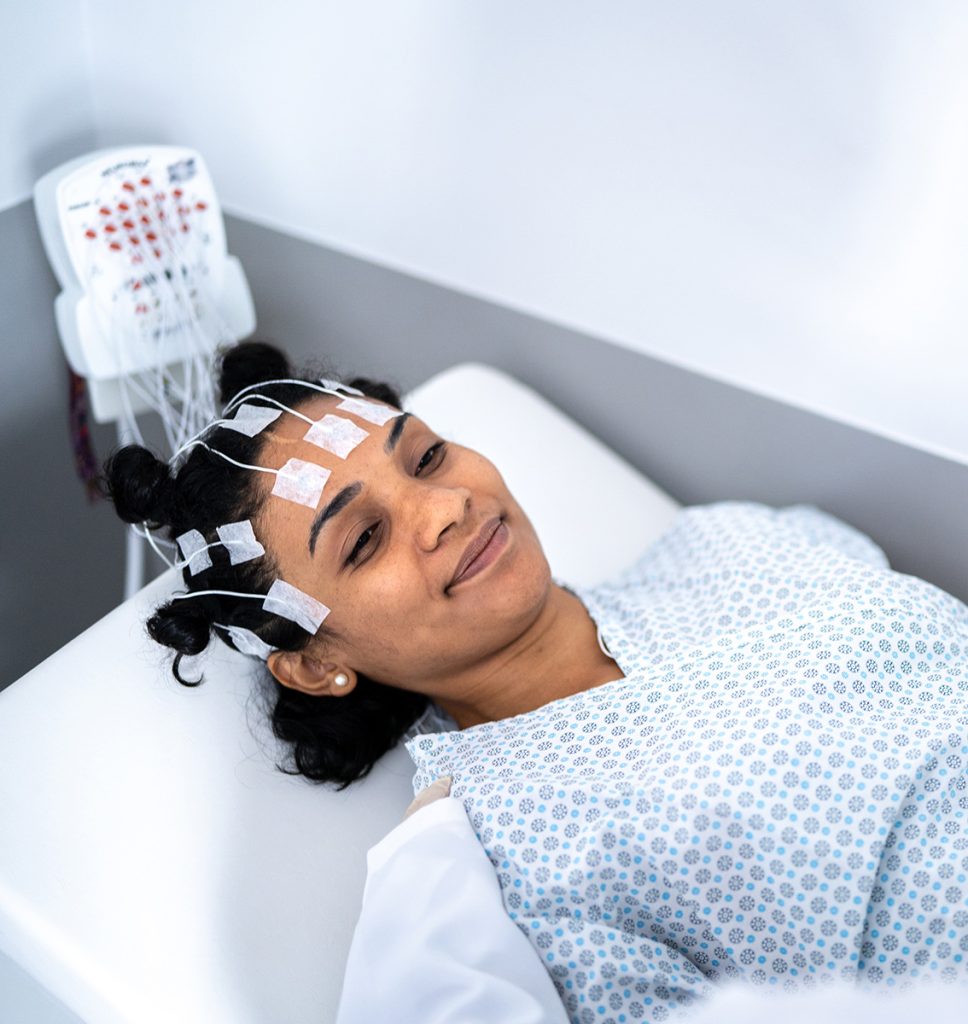
An electroencephalogram (EEG) records activity in the brain. Your brain constantly produces tiny electrical signals. During an EEG test, small sensors, called electrodes, are placed on your scalp. The electrodes are connected by wires to an EEG machine. Electrodes are attached using a special glue or paste.
The electrodes pick up the electrical signals from your brain. These are recorded and displayed on a computer screen. The electrodes only measure the electrical signals. They don’t interfere with your brain or cause you any pain.
The electrical signals look like wavy lines that show your brainwave patterns. The EEG test can only show your brainwave patterns at the time the test is carried out. At different times, your brainwave patterns may be different.
A highly trained specialist, called a clinical neurophysiologist will look at your results. They can recognise if your EEG test shows a brainwave pattern that is unusual. Some of these patterns point to a strong possibility of epilepsy.
When are EEG tests done?
Your doctor might ask you to have an EEG test for one of the following reasons:
- They think you might have epilepsy
- You have epilepsy, and they need to know more about it
- They are unsure whether or not your seizures are due to epilepsy
- You are being considered for epilepsy surgery
- They are thinking about changing or stopping your epilepsy medicines
Sometimes an EEG is done to check whether someone is in non-convulsive status epilepticus. Non-convulsive status epilepticus can change a person’s level of awareness or cause confusion. This might not be recognised as a seizure without an EEG.
The results of an EEG can help doctors to make the correct diagnosis and decide on the best treatment. A doctor who specialises in reading EEG results should interpret them. This is because reading an EEG incorrectly is one of the most common reasons for people to be given the wrong diagnosis. The National Institute for Health & Care Excellence (NICE) guidelines say that the first EEG should ideally be done within 72 hours of the first seizure.
Where are EEG tests done?
An EEG is usually done in hospital in an outpatient clinic. People with epilepsy have told us that they found it helpful to go with someone to the appointment. Some people find the process quite tiring and there is a very small risk you might have a seizure during the test. You may find it useful to plan how you will get home after the appointment.
You might be asked to take a simple piece of portable recording equipment home with you. Your specialist will show you how to use this.
How can I prepare for an EEG?
To help the electrodes stick to your head more easily, have clean, dry hair for the appointment. As well as this, do not use any styling products such as wax or gel.
It could also be helpful to bring a hairbrush or comb as the glue can make your hair messy after the test. Or, you might want to take a hat to cover your hair until you can wash it. After the test, you may still have a lot of glue in your hair. This can be washed out afterwards using baby shampoo, baby oil, or hair conditioner.
Young children might find it helpful to bring a toy or something comforting from home to play with. This can help especially while the electrodes are being stuck on.
Certain hairstyles such as weaves or braids will need to be removed otherwise they may be damaged. This is because the glue will be difficult to get out if you aren’t able to comb through your hair. If braids are not removed, the specialist can put the electrodes between them, but the quality of the EEG may not be as good.
EEGs do not work through material. If you wear a wig, you will need to remove it before the test.
What information does an EEG test give?
An EEG test gives information about the electrical activity that is happening in your brain at the time the test is carried out.
Many people with epilepsy only have unusual electrical activity in their brain when they are having a seizure. The rest of the time the brain activity may be normal. So, if your EEG test doesn’t show any unusual activity, it only means that there is no epileptic activity in your brain at the time the test is being done. This doesn’t prove that you don’t have unusual activity in your brain at other times, and you could still have epilepsy.
People with some types of epilepsy have unusual electrical activity in their brain even when they are not having a seizure. When they have an EEG test, the results can show certain brainwave patterns that doctors recognise. This information is very helpful for doctors when they are making a diagnosis.
A small number of people have unusual EEG test results, even though they never have seizures and they don’t have epilepsy. These could be caused by other medical conditions, problems with their vision, or brain damage. So, an EEG that shows unusual brainwave patterns doesn’t always mean that you have epilepsy.
Can an EEG test show what type of seizures I have?
When an EEG test picks up unusual electrical activity, the doctor will look at where it is happening in the brain. With focal seizures, the activity is only happening in some areas of your brain. With generalised seizures, the activity is more widespread. Unless you have a seizure during the recording, the doctor cannot be absolutely sure what type of seizures you have.
Can an EEG test show if there is any damage in my brain?
An EEG test only gives information about the electrical activity in your brain. It can show if there is unusual electrical activity but it does not show if there are any physical abnormalities of the brain. An MRI or CT scan can do this.
Will I have more than one EEG test?
There are several ways to do an EEG test. And there are several reasons why you might be asked to have more EEGs.
- If you have an EEG test that doesn’t show any unusual electrical activity in your brain, your doctor might ask you to have another.
- It can be helpful, if possible, to have an EEG test at times when you are more likely to have a seizure. For example, this might be early in the morning. Some people have a type of epilepsy that means seizures are more likely at certain times, for example during their menstrual cycle.
Are there risks to having an EEG test?
Will an EEG test cause me to have a seizure?
An EEG test itself will not cause a seizure, but sometimes extra activities are carried out to learn more about your condition. There’s a very small risk that you could have a seizure during these activities. This could be caused by looking at a flashing light (photic stimulation) or breathing deeply (hyperventilation). These activities are usually part of the test. You will be closely monitored and medical professionals will be there to help if you do have a seizure.
Your doctor might ask you to have less sleep than usual before you have some types of EEG tests. The doctor may do this to increase the chances of catching a unusual brain activity during the test. This might also increase the risk of a seizure around the time of having the test.
You will usually have to give your consent to having an EEG test done and for it to be recorded. This is because it is important that you are aware of why the test is done and of its risks, however small they might be.
The Great Ormond Street Hospital website has information on consent for children’s EEGs.
Will having a seizure during an EEG test affect my right to drive?
If you hold a driving licence, having a seizure could mean that you have to stop driving until you have been seizure free for 12 months.
If you are concerned about the risk of having a seizure, talk to the doctor who has asked you to have the test. You may still be able to have the test without the extra activities such as flashing lights and deep breathing. This would mean not increasing your risk of having a seizure.
Got any questions?
Our expert advisors can help you with any questions you might have about your EEG tests or anything else related to living with epilepsy.
What types of EEG tests are there?
-
Standard EEG tests
You will usually have a standard EEG test at an outpatient’s appointment at the hospital. During the test, you sit or lie down. They may ask you to breathe deeply for a few minutes and to look at a flashing light. These activities can change the electrical activity in your brain, and this will show on the computer. This can help the doctor to make a diagnosis.
Your doctor will ask you to keep as still as possible during the test. Movements during the test can affect how clear the electrical recording is, which can affect the results.
A standard EEG test usually takes 20 to 40 minutes, but a typical appointment will last about an hour. This includes some preparation time at the beginning and some time at the end. Other types of EEG test may take longer. You can go home as soon as the test has been done.
If you don’t remember anything about your suspected seizures it can be very helpful to bring someone with you who has seen them. They will be able to describe what happens for you during a seizure.
There are videos on the internet about having an EEG. The Evelina Hospital have produced a video for young people. The experience for an adult is not much different.
-
Sleep EEG tests
Your doctor might ask you to have an EEG test while you are asleep. This could be because your seizures happen when you are asleep. Or you may have had a standard EEG test when you were awake, but it didn’t show any unusual electrical activity. When you are asleep, your brainwave patterns change and may show more unusual electrical activity. There are also some types of seizure that mainly happen during sleep.
A sleep EEG test is usually done in hospital, using a standard EEG machine. Before the test, your specialist may give you some medicine to help you go to sleep. The test lasts for one to two hours and you usually go home once you have woken up.
Sleep EEGs can be particularly useful in young children. This is because there are some epilepsy syndromes which are more common in young children, where seizures mainly happen in sleep.
For some older people, a sleep EEG can also be useful as brainwave patterns related to focal seizures are more likely to be seen in sleep. Focal seizures are the most common type of seizure in older people.
-
Sleep-deprived EEG tests
A sleep-deprived EEG test is done when you have had less sleep than usual. Before you have a sleep-deprived EEG test, your doctor may ask you not to go to sleep at all the night before. Or they may ask you to wake up much earlier than you usually do.
When you are tired, there is more chance that there will be unusual electrical activity in your brain. Your doctor might ask you to have this test if you have had a standard EEG test, but it didn’t show any unusual electrical activity. A sleep-deprived EEG can be helpful if doctors think you are having absence, myoclonic or focal seizures.
The beginning of the sleep-deprived EEG test is the same as a standard EEG test. You may then fall asleep while the EEG is still recording the activity in your brain. The test lasts for a few hours and you usually go home once you have woken up.
-
Ambulatory EEG tests
‘Ambulatory’ means designed for walking. You can have an ambulatory EEG test during your normal daily activities. An ambulatory EEG test is designed to record the activity in your brain over one or more days. This means there is more chance that it will pick up unusual electrical activity in your brain or a seizure, than during a standard or sleep EEG test.
An ambulatory EEG uses electrodes similar to those used on a standard EEG test. However, the electrodes that are attached to your head are plugged in to a small machine that records the results. You can carry the machine in a small bag, so you are able to go about your day. You don’t usually stay in hospital while the test is being done.
Your doctor will ask you to keep a diary of your activities, such as sleeping and eating, while you are wearing the ambulatory EEG. They will also ask you, or somebody who is with you, to keep a detailed record of any seizures you have. They will then be able to match up what has been happening with the results of your brainwave activity on the EEG test results.
-
Video EEG tests
Longer term video EEGs are also known as a video-telemetry. This means you will have an EEG and a video recording that are usually carried out over a few days.
You will usually have had other types of EEG tests before you are considered for a video EEG. Your doctor might ask you to have this for one of the following reasons:
- It’s not clear what type of seizures you have
- Your epilepsy medicine isn’t working well
- There’s a possibility that your seizures are not caused by epilepsy, but something else
You’re being assessed for epilepsy surgery . Video EEG or video-telemetry might be carried out in hospital or at home.
-
Hospital video-telemetry
During this type of video-telemetry test (VT), you need to stay in hospital. A VT involves using a piece of equipment similar to the one used for ambulatory EEG. At the same time, all your activity is recorded by a video camera. The test is usually carried out over a few days. Sometimes your epilepsy medicine is reduced or withdrawn. This is to increase the chances that you will have a seizure that can be recorded.
After the test, doctors can watch the video to see any seizures that you had. They can also look at the EEG results for the time you were having the seizure. This will tell them about any changes to your brainwave patterns at the time of the seizures.
-
Home video-telemetry / Home long term monitoring (LTM)
Home video-telemetry can be done at home in a similar way to an ambulatory EEG. You will be shown how to set up the equipment, which will include a video recorder.
Evelina Children’s Hospital has made a film about home video-telemetry. The film shows how the home video-telemetry service works at Evelina. Services at other hospitals may be different.
-
Invasive EEG-telemetry
Some people who are being considered for epilepsy surgery will have a test called invasive EEG-telemetry (iEEG). This is a less common type of EEG for people with more complex epilepsy. It is only done when the non-invasive tests have not given enough information about seizures to recommend surgery. A neurosurgeon will do an operation to place the EEG electrodes directly onto the surface of the brain or into the brain. The electrodes are called ‘strip’ or ‘grid’ or ‘stereo-EEG’ electrodes.
The reason for iEEG is to find out where exactly your seizures are coming from. Another part of this test is called ‘cortical mapping’. Cortical mapping is done to see exactly which part of your brain is responsible for things like your memory or speech. It is done to reduce the risk of complications after surgery.
How long will it take to get my EEG results?
You will not normally get your EEG test results on the same day. This is because the recordings will need to be studied by the specialist first and then sent to the doctor who requested the tests. It will usually be a few days or weeks before they can discuss your results with you.
If you have any other questions about your EEG test, you could ask your GP, epilepsy specialist or epilepsy specialist nurse. You could also ask the person who is carrying out the test.
What might happen next?
Once you’ve got the results from your EEG you might:
- Have another standard EEG or one of the other types listed above
- Have an MRI scan
- Have an ECG (electrocardiogram) scan to check for heart-related conditions that can cause symptoms that look like a seizure
- Have blood tests to check your general health and to see if anything else may be causing your symptoms
- Have genetic testing if your specialist thinks you might have a type of genetic epilepsy
For more information on these steps and being diagnosed with epilepsy, please see our page on diagnosing epilepsy.
For parents and children
BBC iPlayer has a CBeebies episode about going to have an EEG test. Your child may find this helpful so they can understand what to expect.
This short animation was made by Hull University Teaching Hospitals NHS Trust. It is designed to help children understand what to expect during an EEG.
The Great Ormond Street Hospital website also has information for children about EEG tests.
New EEG technology – 24/7 EEG SubQ
A new type of EEG has been developed recently known as the 24/7 EEG SubQ (subcutaneous electroencephalography). This type of EEG is currently in the trial stages of research at several NHS trusts across the UK. It is a long-term recording device and is aimed at adults with epilepsy where treatments have not helped to control seizures. It monitors and counts the amount and type of seizure the person has, and measures other scientific data. The aim of the 24/7 EEG SubQ is to provide more detailed information about the seizures.
The system is made up of an EEG electrode that is placed under the skin, plus an external recording device, and specialist technology for reading the data. There are two types of the 24/7 EEG SubQ, one includes a magnet, and one without. The implant can stay in place for up to 15 months to get as much information as possible.
Read Murray's story about his EEG SubQ
Murray thought he was having 5 or 6 seizures a month. But the EEG SubQ fitted showed that he was having up to 25 every month. It also recorded up to 300 sub-clinical seizures in a year (these are seizures that happen where the symptoms are not noticeable).
You can hear more about Murray’s story here.