


Jump to the info you need:
Key points
- People with photosensitive epilepsy have seizures caused by triggers they can see. For example, flashing lights or strong patterns
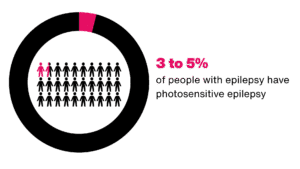
- Not everyone with epilepsy has photosensitive epilepsy. Just 3 to 5 in every 100 people with epilepsy have seizures caused by these visual triggers
- Most cases of photosensitive epilepsy develop in people under 20 years old
- The right epilepsy medicine can help to control your seizures if you have photosensitive epilepsy
- There are lots of other things that you can do to reduce your risk of having seizures caused by visual triggers
- If you see a possible trigger without warning, cover one eye with your hand and turn away. Do not close your eyes
What is photosensitive epilepsy?
People with photosensitive epilepsy have seizures that are ‘visually provoked’. These seizures are a type of reflex seizure. This means they happen every time you encounter a specific trigger. This could be flashing or flickering lights, or patterns.
Most people who have photosensitive epilepsy also have seizures that are triggered by other things too. But some people will only have visually-provoked seizures.
Around 8 in 10 people with photosensitive epilepsy have generalised tonic-clonic seizures. Other types of photosensitive seizure are also possible, including myoclonic and absence seizures.
How common is photosensitive epilepsy?
Photosensitive epilepsy affects around 1 in 4000 people overall. Not everyone with epilepsy has photosensitive epilepsy. Only around 3 to 5 in every 100 (3 to 5%) people with epilepsy will have photosensitive epilepsy.
Women are more likely to have photosensitive epilepsy than men. Studies suggest that around twice as many females have photosensitive epilepsy as males.
Genetics may also be involved in photosensitive epilepsy. For example, you may be more likely to have photosensitive epilepsy if a parent also has it. But this is not always the case.
Can you grow out of photosensitive epilepsy?
Some people with photosensitive epilepsy may eventually stop having photosensitive seizures.
Photosensitive epilepsy is more likely to affect younger people. Many people who develop it are under 20 years of age. It often begins around the time of puberty.
For some people, it may improve as they get older. For others, it does not go away. People with a family history of photosensitive epilepsy are more likely to continue having seizures as they grow older.
What types of epilepsy are linked to photosensitive seizures?
Photosensitive seizures are more common in some types of epilepsy and epilepsy syndromes. Click on each condition below to find out more about a specific epilepsy:
- Juvenile myoclonic epilepsy
- Childhood absence epilepsy
- Epilepsy with generalised tonic-clonic seizures alone
- Juvenile absence epilepsy
- Myoclonic epilepsy in infancy
- Epilepsy with eyelid myoclonia (Jeavons syndrome)
- Lennox Gastaut syndrome
- Dravet syndrome
How do I know if I have photosensitive epilepsy?
Doctors can use an EEG test to detect if you are photosensitive. EEG stands for electroencephalogram. This test records electrical activity in the brain.
During the EEG, you will be asked to look at flashing lights and/or other types of visual stimuli such as structured patterns (bars). The EEG can record if these cause specific changes in your brain activity. If they do, it may mean you have photosensitive epilepsy.
If you notice any symptoms or seizure patterns associated with exposure to lights, note down what happens. You can speak to your GP or epilepsy specialist and they can refer you for further tests if necessary.
We have a free seizure diary that you can use to track changes to your seizures or symptoms.
How to check your medical records
If you have a diagnosis of epilepsy, you might have already had an EEG. Your medical record will say if you have been tested for photosensitive epilepsy. Your GP or epilepsy specialist can give you this information. Or, you can find out by accessing your medical records online.
What can trigger photosensitive seizures?
There are many possible visual triggers for photosensitive epilepsy. They can be different for each person. Not every trigger will affect every person with photosensitive epilepsy.
Flashing or flickering lights
Flashing lights are a common trigger for people with photosensitive epilepsy. A light may be most likely to trigger a seizure if it flashes or changes colour at a rate between 10 and 25 flashes per second. But some people can be sensitive to lights that flash as slow as 3 times a second or as fast as 60 times per second.
The light is more likely to trigger a seizure if it reaches both eyes. This is why covering one eye can help to prevent light-stimulated seizures.
A flashing light may also be more likely to trigger a seizure in some people if it:
- Is very bright
- Takes up at least 10% of the area that you can see. This is called your visual field
- Lasts for at least half a second
The rate that a light flashes is sometimes measured by Hertz. If a light flashes 25 times per second, it may be written down as 25 Hertz or 25 Hz.
What types of lighting can cause seizures?
Many types of flashing lights can cause photosensitive seizures for some people. These include:
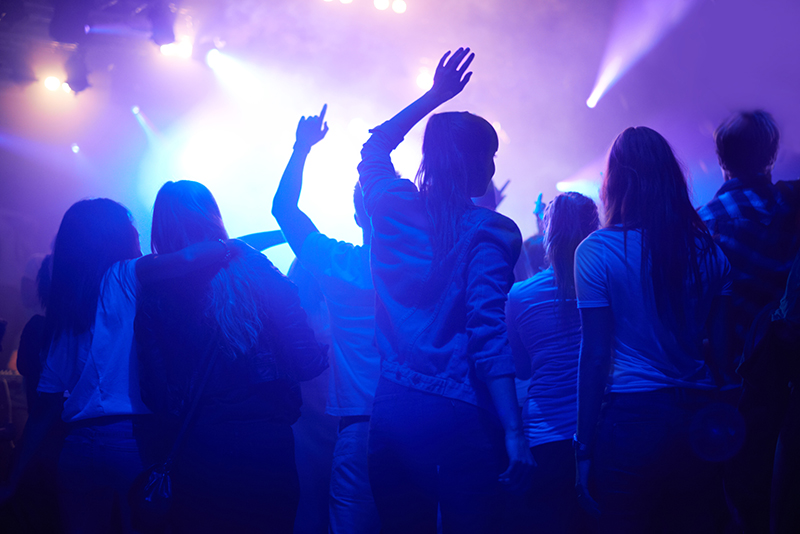
- Strobe lighting at concerts or in clubs
- Rapid camera flashes
- Flickering light bulbs
- Some Christmas lights and fireworks
Can bicycle lights cause seizures?
Red and white bicycle lights used in the UK are covered by a specific law for road vehicles. The law says that these lights must flash between 1 and 4 flashes a second (1 to 4 Hz). If a light complies with this law, it is unlikely to cause a problem.
However, other countries have different rules. Bike lights that are not made for the UK may flash at a different frequency.
Can LED and strip lights cause a seizure?
Standard light bulbs do not usually trigger photosensitive seizures. Fluorescent strip or tube lights are also usually fine. But these lights might cause problems if they are faulty. Or, if the wrong type of bulb is used, causing the light to flicker.
LED lights do not seem to be a common trigger for people with photosensitive epilepsy, unless they are flashing. But we do not have enough research to be sure.
What are UK regulations for lighting at work?
UK workplace regulations require that employers consider employees’ needs. The Health and Safety Executive has guidance for lighting at work. Employers should provide appropriate lighting or adequate control measures to prevent the risk of seizures.
Find out more about workplace guidelines and your rights if you have epilepsy. Or contact our Helpline on 0808 8005050 to talk to one of our trained advisors.
Sunlight and rotating blades
Other triggers for photosensitive epilepsy include moving sunlight. For example:
- Sunlight through trees, hedges, or railings, especially if seen from a moving vehicle
- Sunlight through slatted blinds
- Sunlight reflected off moving water or off snow
- Dappled sunlight through leaves
Some types of rotating blades might also trigger seizures, for example:
- Helicopter blades rotating at a fast speed
- Smaller turbines and blades that rotate quickly. These can potentially trigger a seizure if they create a shadow or a flicker effect with the light. This risk decreases the further away you are
Large wind turbines are unlikely to trigger a seizure as their blades rotate at a slow rate.
Patterns and colour changes
Repetitive patterns such a strong stripes or checks can trigger seizures. For example:
- Repeating high contrast patterns such as black and white stripes or zig zags
- A moving escalator
- Strong patterns or colour changes in some television programmes, video or electronic games. Particularly when moving from a strong red colour to a very different colour, like blue
Patterns on screens
Research suggests that patterns on an electronic screen can be more likely to trigger a seizure for some people if:
- There are at least 5 to 8 pairs of repeating stripes
- They are very bright and cover a larger portion of your field of vision
- They appear for longer than half a second
- They vibrate, reverse colours or flicker
Online content, TVs, and video games
Content with flashing imagery or animated patterns can potentially trigger seizures:
- Online content in social media videos and GIFs
- On television
- In video games, including 3D games and virtual reality games
- Films at the cinema. Although this is less likely due to the dimmer screen lighting used in cinema theatres
We talk more about how to reduce your risk from this type of content below.
Can screens cause photosensitive seizures?
Newer TV screens and monitors don’t usually have a visible flicker. They update or ‘refresh’ the picture at faster speeds that are not likely to trigger a seizure.
Older ‘cathode ray’ TV sets, which look more boxy and have solid glass screens, tend to refresh at a slower speed. This can pose a risk for people with photosensitive epilepsy. However, this type television is now quite rare and difficult to buy. This makes them less of a risk.
Modern technology is always changing, and it is worth investigating what is safe for you. For example, high-definition or curved screens that take up more visual space might increase the risk of a seizure for some people.
Smaller screens, like mobile phones, are less likely to trigger seizures because they take up less of your field of vision. But they could if they flash very brightly and are held close to your face.
How is photosensitive epilepsy treated?
The most common way to treat photosensitive epilepsy is with epilepsy medicines. This can lower the risk of having a seizure. If your epilepsy is well controlled by medicines, you are also less likely to have photosensitive seizures.
Many people find the most effective way of preventing or reducing seizures is to:
- Take epilepsy medicines, and
- Avoid seizure triggers
Tips and tools to protect yourself from visual triggers
Avoiding seizure triggers is an effective way to reduce seizures. This might mean reducing your exposure to visual triggers where you can. It can also mean managing other common seizure triggers, such as tiredness and alcohol intake.
Here are some ways you can manage your exposure to possible photosensitive seizure triggers.
1. Avoid potential triggers when you can
Consider using dark or coloured glasses and hats with wide brims when you are outside.
Light must reach both eyes to trigger a seizure. If you come across something that might trigger a seizure without warning:
- Cover one eye with the palm of your hand straight away
- Turn away from the possible trigger, or leave
- Don’t close your eyes as this could cause a flicker effect
2. Check content advice before watching
In the UK, films and TV programmes must warn viewers if they contain material that could trigger photosensitive epilepsy. For films, you can find these warnings on the British Board of Film Classification (BBFC) website.
The World Wide Web Consortium (W3C) have specific accessibility guidelines. They aim to reduce the risk of online content affecting people with photosensitive epilepsy. Read more about these and other guidelines for online content.
Concerts and performances will sometimes warn if strobe lighting is used during the show. But not always. It might be worth asking organisers before the show starts.
3. Adjust how you view content
Think about your environment
- View screens from further away. This will reduce brightness and the area of your vision taken up by the screen. Try to stay away from the screen by at least 2 metres (6 feet) or 3 times the width of the screen
- Increase the brightness of your environment. If indoors, try to make sure the room is well lit. For example, put a lamp by the TV or monitor
Think about your screen
- Consider using a smaller screen
- Use a flat screen with a high refresh rate. Plasma and LCD screens that refresh at least 100 times per second (100 Hz) are less likely to trigger a seizure than older TVs and computer monitors.
- Place an anti-glare filter over the screen or use a downloadable screen filter
Consider your settings
- Lower the brightness and contrast settings on screens and video games where possible
- Change the settings on your social media platforms so that videos and GIFs do not automatically play. Your mobile phone might also have a setting to disable autoplay
- Try not to use animated backgrounds if using video conferencing software. Consider asking others to do the same
- Some online platforms like Zoom allow you to enable video dimming in your personal settings. This can help to reduce the impact of flashing effects in shared content
4. Think about other seizure triggers
Sometimes different triggers can combine to increase the chance of having a seizure.
Spending a long time in certain lighting, or on screens, may contribute to tiredness, or fatigue. This can be a seizure trigger for some people with epilepsy, even if you do not have photosensitive epilepsy.
- Avoid screen time if you are feeling very stressed, tired or have not had enough sleep
- Try to limit the amount of time you spend using screens and take regular breaks
Find out more about common seizure triggers and how to manage your wellbeing.
Can glasses help with photosensitive epilepsy?
There is some evidence that wearing glasses with dark lenses may protect you from triggers on screens and in the natural environment. The dark lenses help to reduce brightness. Polarised lenses may also help. This is because they decrease brightness. But they may not be completely protective.
Wearing hats with a brim can also help when outside.
Can Z1 lens glasses help reduce seizures?
People with photosensitive epilepsy may benefit from glasses with coloured lenses. Particularly blue coloured lenses. Studies show that wearing glasses with a dark cobalt blue lens, called a ‘Z1 lens’, can help prevent photosensitive seizures.
These lenses work by reducing the total amount of light and filtering out red light. Red is the colour most likely to trigger a seizure. These glasses are not suitable for driving. This is because Z1 lens glasses block out red light it can be hard see red or amber lights.
You can buy coloured glasses online or from an optometrist. Different people find different types and strength of colour effective. You might want to try out a few different types first.
It might also be worth asking your epilepsy specialist or an optometrist if these glasses could be helpful for you.
Can I drive with photosensitive epilepsy?
Many people with epilepsy can drive, if they meet the driving rules for their type of seizures.
Find out more about driving rules for epilepsy.
How can I help someone having a photosensitive seizure?
If you see someone having a photosensitive seizure:
- Stay calm
- Stay with them until they are fully recovered
- Follow some simple steps to keep them safe. Find out more about first aid for seizures
How do I complain about flashing lights or triggering content?
-
Talk to your local council
Contact your local council to complain about flashing artificial lights. They will consider complaints about ‘nuisance lights’.
These might be:
- Security lights (domestic and commercial)
- Sports facilities (like floodlit football pitches)
- Decorative lighting of buildings or landscapes
- Laser shows and light art
More information on what counts as a statutory nuisance is available on the government website.
The council will consider whether the light may affect health. They will assess how the lights are likely to affect the ‘average person’. They do not include ‘unusual sensitivities’ in their assessment. This means they may not take photosensitive epilepsy into account.
-
Talk to online platforms and regulators
You can report online content to the relevant social media platform or online service.
You can also complain to Ofcom or the Advertising Standards Agency about online content and programmes broadcast on TV.
Read more about standards and guidelines for UK content.
Online epilepsy trolling
Thanks to ‘Zach’s law’, it is now a criminal offence to send or show flashing images electronically to people with epilepsy. If you need to report a targeted incident, tell the relevant online platform and the police.
-
Talk to us
We campaign to improve the lives of everyone affected by epilepsy.
We would like to hear from you if you come across flashing lights that are likely to affect a large number of people. We would also like to hear if you have complained about a TV programme or online video but are unhappy with the reply you have received.
Contact our campaigns team at campaigns@epilepsy.org.uk.
This page is printable and can be downloaded. We also have accessibility tools available at the top of the page.
Thank you to Professor Stefano Seri, Consultant Clinical Neurophysiologist at Birmingham Women’s and Children’s NHS Foundation Trust, and our health information volunteers, for their help contributing to and reviewing this content.
Find out more about how you can help us create our health information.
-
Sources
Verrotti, A, et al., (2012) ‘Photosensitivity: Epidemiology, Genetics, Clinical Manifestations, Assessment, and Management.’ Epileptic Disorders 14 (4), pp. 349–62. Available at: https://doi.org/10.1684/epd.2012.0539
Fisher RS, et al., (2022) Visually sensitive seizures: An updated review by the Epilepsy Foundation. Epilepsia, 63, pp. 739–768. Available at: https://doi.org/10.1111/epi.17175
Padmanaban, V, et al., (2019) ‘Clinical Advances in Photosensitive Epilepsy.’ Brain Research, Challenging Spontaneity: Do Seizures Really Arise Out of Thin Air?, 1703, pp. 18–25. Available at: https://doi.org/10.1016/j.brainres.2018.07.025
Covanis, A., (2005) ‘Photosensitivity in Idiopathic Generalized Epilepsies.’ Epilepsia 46(9), pp. 67–72. Available at: https://doi.org/10.1111/j.1528-1167.2005.00315.x.
Shovon S. (2010) Handbook of Epilepsy Treatment, 3rd edition, Wiley-Blackwell, p.72.
Martins da Silva, A. et al., (2017), ‘Photosensitivity and Epilepsy: Current Concepts and Perspectives—A Narrative Review.’ Seizure 50 pp. 209–18. Available at: https://doi.org/10.1016/j.seizure.2017.04.001
Asch, C. J. J. et al., (2024) ‘Photosensitivity and Self-Induction in Patients Aged 50 and Older.’ Epileptic Disorders 26(3) pp. 293–301. Available at: https://doi.org/10.1002/epd2.20209
NICE (2025) Epilepsies in children, young people and adults. Available at: https://www.nice.org.uk/guidance/ng217/chapter/1-Diagnosis-and-assessment-of-epilepsy. (Accessed on 25 June 2025)
Trenité, D. et al., (2025) ‘Frequently Asked Questions and Answers on Visually-Provoked (Photosensitive) Epilepsy.’ Epilepsy & Behavior Reports, 100753, Available at: https://doi.org/10.1016/j.ebr.2025.100753
Brinciotti, M.et al., (2021) ‘Pattern-Sensitive Patients with Epilepsy Use Uncomfortable Visual Stimuli to Self-Induce Seizures.’ Epilepsy & Behavior 122, 108189. Available at: https://doi.org/10.1016/j.yebeh.2021.108189
GOV.UK (no date), The Road Vehicles Lighting (Amendment) Regulations 2005. Available at: http://www.legislation.gov.uk/uksi/2005/2559/regulation/9/made (Accessed: 25 June 2025)
Cycling UK (no date), Everything you need to know about cycle lighting regulations. Available at: https://www.cyclinguk.org/lighting-regulations (Accessed: 25 June 2025)
Binnie, C. D. et al., (1979).’Fluorescent Lighting and Epilepsy.’ Epilepsia 20(6) pp. 725–27, Available at: https://doi.org/10.1111/j.1528-1157.1979.tb04856.x
Health and Safety Executive (1997) Lighting at work. Available at: https://www.hse.gov.uk/pubns/priced/hsg38.pdf. (Accessed: 25 June 2025)
Harding, G. et al., (2008) ‘Wind Turbines, Flicker, and Photosensitive Epilepsy: Characterizing the Flashing That May Precipitate Seizures and Optimizing Guidelines to Prevent Them.’ Epilepsia 49(6) pp. 1095–98. Available at: https://doi.org/10.1111/j.1528-1167.2008.01563.x
Smedley, A.R.D., et al., (2010) ‘Potential of wind turbines to elicit seizures under various meteorological conditions.’ Epilepsia, 51, pp. 1146-1151. Available at: https://doi.org/10.1111/j.1528-1167.2009.02402.x
Panayiotopoulos CP. (2005), The Epilepsies: Seizures, Syndromes and Management. Chapter 13, Reflex Seizures and Reflex Epilepsies. Available at: https://www.ncbi.nlm.nih.gov/books/NBK2596
Wilkins, A., et al., (2005), Characterizing the Patterned Images That Precipitate Seizures and Optimizing Guidelines To Prevent Them. Epilepsia, 46, pp. 1212-1218. Available at: https://doi.org/10.1111/j.1528-1167.2005.01405.x
Jordan, J.B. et al., (2024) ‘International Guidelines for Photosensitive Epilepsy: Gap Analysis and Recommendations.’ ACM Trans. Access. Comput. 17(3) pp. 17:1-17:35. Available at: https://doi.org/10.1145/3694790
Checa-Ros, A. et al., (2021) ‘Efficacy of color lenses in abolishing photosensitivity: Beyond the one-type-fits-all approach?’, Epilepsy & Behavior, 124, p.2 Available at:10.1016/j.yebeh.2021.108332
GOV.UK (no date) Artificial light nuisances: how councils deal with complaints. Available at: https://www.gov.uk/guidance/artificial-light-nuisances-how-councils-deal-with-complaints#how-artificial-light-nuisances-are-assessed (Accessed: 25 June 2025)
Got any questions?
Our expert advisors can help you with any questions you might have about photosensitive epilepsy or anything else related to living with epilepsy.